

27 May Why One Backup Is Never Enough: Protecting Your Business Data
Your business depends on its data. But how confident are you that you could recover it if something went wrong?
In today’s increasingly digital world, businesses rely on technology for almost everything, from customer records and financial information to emails, documents, websites and day-to-day operations. Yet one of the most important aspects of business IT is often overlooked: having a reliable, secure and properly managed backup strategy.
At Boldon.tech, we believe that protecting your data shouldn’t be complicated, but it should never be left to chance. Whether you’re a sole trader, a growing business or a larger organisation managing multiple systems, having more than one backup could make the difference between a minor inconvenience and a major business disruption.
The Problem with Having Just One Backup
Many businesses believe their data is safe simply because they regularly copy files to an external hard drive, network storage device or cloud service.
Unfortunately, a single backup is not always enough.
Consider what would happen if your office experienced a fire, flood or burglary. If your computer and backup drive were stored in the same building, both could be lost simultaneously.
Alternatively, a hardware failure, accidental deletion, malicious software or ransomware attack could compromise your original data and any backups connected to the same network.
Even cloud storage services aren’t automatically a complete backup solution. Many services synchronise files between devices, meaning accidental deletions or unwanted changes can sometimes be replicated across every connected computer.
The simple truth is that a backup is only valuable if it remains available, intact and recoverable when you need it.
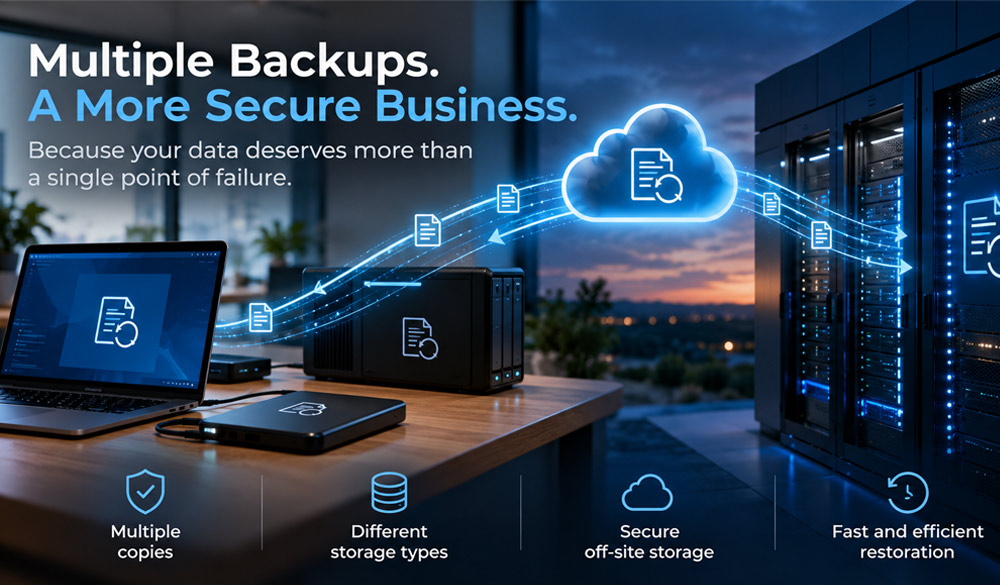
That’s why we recommend a carefully planned approach involving multiple backups, secure off-site storage and regular recovery testing.
Understanding the 3-2-1 Backup Strategy
One of the most widely recognised approaches to protecting business information is known as the 3-2-1 backup strategy.
It’s a straightforward concept that every business owner should understand:
- 3 copies of your data: Your original files and at least two separate backups.
- 2 different storage types: Keep your data on different types of storage or independent systems to reduce the risk of a single failure affecting everything.
- 1 off-site copy: Maintain at least one backup in a separate physical location to protect against incidents affecting your premises.
For additional protection against ransomware, businesses can extend this approach by maintaining an offline or immutable backup — a copy that cannot easily be altered or deleted by an attacker.
This layered approach dramatically improves your chances of recovering important information after an unexpected incident.
And importantly, it doesn’t have to be expensive or complicated.
Why Off-Site Backups Are So Important
Imagine arriving at work one morning to discover that your main computer system has failed. Perhaps a server has stopped working, a storage device has become corrupted or your business has been targeted by ransomware.
Now imagine discovering that your only backup has also been affected.
Without an independent copy of your data, recovery could become extremely difficult, expensive or, in some cases, impossible.
Off-site backups provide an essential additional layer of protection by storing your information away from your primary systems.
Depending on your business requirements, these backups can be maintained securely at another physical location, within dedicated remote storage infrastructure or through an appropriately configured cloud-based backup service.
Modern backup technology can also automate the entire process, transferring new and updated information at scheduled intervals without requiring constant attention from employees.
At Boldon.tech, we design solutions that make this process as seamless as possible, ensuring information is transferred efficiently, stored securely and available for restoration when required.
Backing Up Your Data Is Only Half the Job
One of the biggest misconceptions about data protection is that successfully completing a backup automatically guarantees successful recovery.
Unfortunately, this isn’t always the case.
Backup files can become corrupted, scheduled processes can stop working, storage devices can fail and systems can change over time.
A backup that hasn’t been checked for months may provide little reassurance when disaster strikes.
That’s why a comprehensive backup strategy should include:
- Automated backup schedules to reduce the risk of human error.
- Multiple independent copies to protect against hardware failures and data loss.
- Secure off-site storage to safeguard information against incidents at your premises.
- Encryption and access controls to help protect confidential business information.
- Monitoring and reporting to identify failed or incomplete backups.
- Regular restoration testing to confirm that files and systems can actually be recovered.
- A documented recovery plan so everyone knows what needs to happen when something goes wrong.
Ultimately, the question shouldn’t simply be, “Are we backing everything up?”
It should be, “If our systems failed today, how quickly could we get our business running again?”
Backup Solutions Designed Around Your Business
Every business is different, and a backup system that works perfectly for a small office may not be appropriate for an organisation operating multiple servers, sites or large volumes of information.
That’s why Boldon.tech doesn’t believe in a one-size-fits-all approach.
We can design, implement and manage backup solutions of all sizes, tailored to your existing infrastructure, operational requirements and budget.
From straightforward automated backups for individual computers and small businesses to more sophisticated systems involving network-attached storage (NAS), dedicated backup servers, secure remote replication and off-site storage, we can help create an infrastructure that provides the protection your organisation needs.
Our solutions can be designed to provide:
Fast and efficient data transfer
Using appropriate backup technologies, incremental backups and efficient data transfer methods, we can minimise unnecessary network traffic while keeping remote copies up to date.
Secure off-site storage
We can design and configure remote storage systems that maintain independent copies of your important business information away from your primary premises.
Centralised backup management
Where appropriate, multiple computers, servers and storage devices can be monitored and managed through a centralised system, making it easier to oversee backup activity and identify potential problems.
Fast and efficient restoration
Should the unexpected happen, your backup infrastructure can be designed to support efficient recovery of individual files, complete systems or larger volumes of business data.
Scalable infrastructure
As your business grows, your backup solution can grow with it, accommodating additional devices, increased storage requirements and changing operational needs.
Most importantly, we focus on making these systems reliable, practical and straightforward to manage.
How Much Downtime Could Your Business Afford?
For many businesses, the true cost of data loss goes far beyond replacing a computer or hard drive.
Lost information can result in interrupted operations, missed deadlines, unhappy customers, lost revenue and potentially serious reputational damage.
Depending on the information involved, businesses may also face contractual or regulatory obligations relating to data protection and retention.
A properly designed backup and recovery system can significantly reduce these risks.
An important part of our approach is understanding two simple questions:
How much information could your business afford to lose?
For example, would losing a day’s work be acceptable, or would you need access to information saved within the last hour?
How quickly would your systems need to be restored?
Could your organisation operate without its main systems for a day, or would a prolonged interruption cause significant problems?
The answers help determine how frequently backups should run, where information should be stored and which recovery technologies would be most appropriate.
By understanding these requirements from the beginning, Boldon.tech can design a backup strategy that balances protection, performance and cost.
Prevention Is Better Than Recovery
Technology failures rarely happen at convenient times.
A hard drive doesn’t wait until you’ve finished an important project before failing, and ransomware doesn’t give you advance notice before disrupting your systems.
However, the consequences of these incidents can be substantially reduced through sensible planning and reliable backup infrastructure.
At Boldon.tech, our goal is to help businesses prepare for the unexpected rather than struggle to recover afterwards.
Whether you need to improve an existing backup arrangement, introduce secure off-site storage or develop a comprehensive backup and disaster recovery strategy, we can help you understand your options and implement a solution suited to your business.
Is Your Business Data Properly Protected?
If you’re unsure whether your current backups are sufficient, or you’ve never tested whether your business could recover from a major system failure, now is a good time to review your arrangements.
Boldon.tech can help design, implement and manage reliable, secure and scalable backup systems, including fast and efficient off-site storage, backup monitoring and data restoration.
From a single workstation to complex business infrastructure, we can help ensure your valuable information is protected and recoverable.
Don’t wait until something goes wrong to discover that your backups aren’t enough.
Contact Boldon.tech today to discuss your business backup and disaster recovery requirements.
Boldon.tech — Practical technology solutions, professional support and peace of mind.